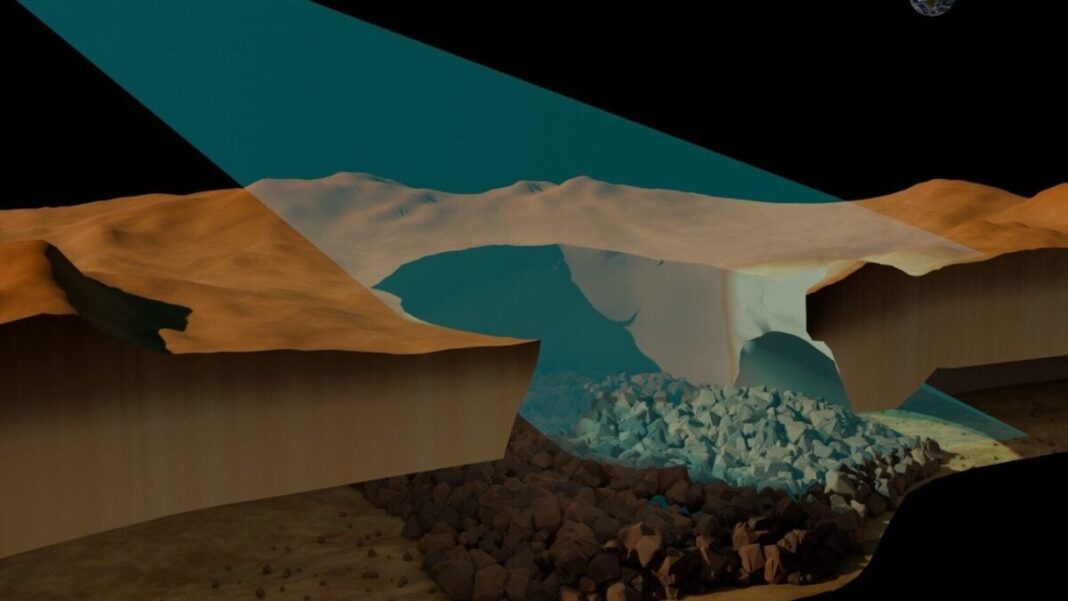

Scientists may have found the first evidence of underground tunnels lurking beneath the surface of Venus, carved by the planet’s ancient volcanic activity.
A team of researchers from the University of Trento spotted what appears to be an underground lava tube on Venus, the first subsurface feature ever detected on the volcanic world. The findings, detailed in a study published in Nature this month, could confirm long-held theories about Venus’ volcanism and how it shaped the planet.
“Our knowledge of Venus is still limited, and until now we have never had the opportunity to directly observe processes occurring beneath the surface of Earth’s twin planet,” Lorenzo Bruzzone, a professor at the University of Trento and co-author of the study, said in a statement. “The identification of a volcanic cavity is therefore of particular importance, as it allows us to validate theories that for many years have only hypothesized their existence.”
Secret cave
The scientists behind the study scoured through radio data collected by the Megallen mission between 1990 and 1992. The spacecraft pierced through Venus’ thick clouds to map its surface using synthetic aperture radar.
The team analyzed the radar images to search for signs of localized surface collapse, and found what they believe to be an empty, subsurface lava tube near the planet’s Nux Mons volcano. The lava tube is around 0.6 miles wide (1 kilometer), which is larger than ones found on Earth and Mars. Its roof has a thickness of around 490 feet (150 meters) and it boasts an empty cavity that’s at least a quarter of a mile (375 meters) high.
Lava tubes are underground tunnels that are created by volcanic activity. They usually form as a by-product of basaltic lava flows, where low viscosity lava continues to flow beneath a surface of solidifying lava.
Venus is the most volcanically active planet in the solar system, and the planet’s extreme volcanism has shaped its surface. Scientists have long theorized that Venus’ volcanic history may have also resulted in a large underground network of lava tubes, but that has so far been hard to detect due to the planet’s dense atmosphere.
Underground tunnels
The detection of the first lava tube on Venus suggests there may be more lurking beneath the planet’s surface. “This discovery contributes to a deeper understanding of the processes that have shaped Venus’s evolution and opens new perspectives for the study of the planet,” Bruzzone said.
The researchers behind the study suggest that new high-resolution images and data acquired by radar systems that penetrate the surface are needed to determine whether there are more lava tubes on Venus.
Upcoming missions such as NASA’s VERITAS and the European Space Agency’s EnVision, both set to launch in 2031, may just have what it takes to peer beneath the surface of Venus in search of ancient tunnels carved by the planet’s volcanic history.