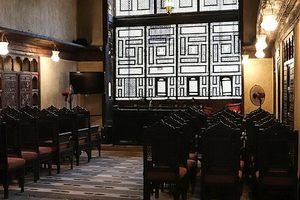

Amidst the chaos of Port Said Street at the heart of a crowded quarter of historic Cairo, it’s easy to miss the small yellow sign labeled “Bayt al-Sinnari” (the House of the Man from Sennar). But if you follow the signs down a nondescript alley and through the carved stone doorway, you will find yourself in an 18th century palace whose walls tell the tale of a Sudanese slave who rose to become one of the most powerful men in Egypt… and of the beginnings of modern Egyptology.
What we know about Ibrahim Katkhuda al-Sinnari, the Man from Sennar, comes from the historian Al-Jabarti’s chronicle of 18th century Egypt. Al-Jabarti tells us that Ibrahim had black skin and came from a tribe of “barbarians” in what is now Sudan. Like so many of his countrymen of the era, it seems that Ibrahim was kidnapped from his home and transported up the Nile to Egypt as a slave. He began his career as a lowly enslaved doorman in the city of Mansoura. Gifted with a brilliant mind and abilities in divination, he defied his status and fought his way up the social ladder. He became fluent in Turkish and ingratiated himself with the Mamluks, the ruling elite of the era. Ibrahim rose in power until he became the trusted deputy of Murad Bey—the co-regent of Egypt and chieftain of the Mamluks.
In keeping with his new status, Ibrahim built himself a palace in the Mamluk style with courtyard gardens, marble fountains, carved wooden ceilings, and intricate lattice window screens. At the time, the palace was located in one of the most desirable locations in Cairo, outside the walls of the medieval city, beside a canal that carried fresh water from the Nile, and a stone’s throw from the holy shrine of Sayyida Zainab (the granddaughter of the Prophet Muhammad). Al-Jabarti tells us that Ibrahim even had his own slaves to serve him, both black and white.
Ibrahim’s hard-earned success came to an abrupt end when Napoleon Bonaparte invaded Egypt in 1798. He died in 1801 – reports differ as to whether he was killed by the Ottomans or while battling the French army alongside his Mamluk brethren. He was buried in Alexandria.
But his palace had its own afterlife. As one of the finest homes in Cairo, it was commandeered by the French to house a group of scholars who accompanied the army to survey the newly-conquered territory. Between 1798 and 1801, in the dappled light of Ibrahim’s latticed windows, the scholars prepared a pathbreaking 37-volume study of ancient, medieval, and modern Egypt. The so-called Description de l’Égypte is considered the first work in the field of Egyptology, and its detailed descriptions and engravings of ancient sites are still essential to researchers today.
The house seemingly lay abandoned until it was taken under the protection of the Commission for the Preservation of Arab Monuments at the beginning of the 20th century. The Commission leased the space to a certain Goyardon Bek from 1917 to 1926 to use as a museum dedicated to findings made during the French Campaign on Egypt. After Bek’s death in 1933, plans were made to turn the house into the Napoleon Bonaparte Museum, but they were never realized. In 1948, the house was bought by the Egyptian Antiquities Authority and officially declared a monument – it briefly served as the Center of Archaeological Crafts in the 1960s, but was otherwise in disuse until the end of the 20th century.
After an earthquake shook Cairo in 1992, Ibrahim’s former palace underwent renovations and was restored in 1996 as Bayt al-Sinnari, a cultural center managed by the Bibliotheca Alexandrina. Visitors are welcome to explore the warren of rooms and courtyards during opening hours. There is also a busy calendar of free crafts workshops, art exhibits, book talks, and other events for the local community, including a popular series of evening concerts in the garden.