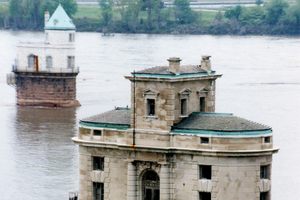

By the late 19th century, St. Louis was one of the largest cities in the U.S. Like seemingly all such growing cities, it faced the problem of where to source enough water for its population. Much of the Mississippi River around the city was polluted, so it was decided to locate the St. Louis Water Works further north at Bissell’s Point. Likewise, the city’s water intake structures were built nearby at the shallow Chain of Rocks rapids. From here, water was funneled to the Water Works in underground pipes.
The first of these buildings, capped by a conical tower, was built in 1894 in a Romanesque Revival design by William S. Eames. The second one, actually located across the state line in Illinois, was constructed in 1913 in the Renaissance Revival style by Roth and Study. In addition to water collection features, the second one has living quarters for caretakers who would work on week-long shifts. To keep the water clean, they had to do without bathrooms.
The intake towers have not been used since 1993, when a flood inundated the towers’ pipes with mud and debris. Despite that, the towers remain as city landmarks and unique features along the Mississippi. Once or twice a year, maintenance crews come to check on the towers. Docking and climbing the access ladders is reportedly a difficult process, as one could easily get swept away into the rapids!