
The Tule Tree is the main attraction and most important symbol of the town of Santa María del Tule. Despite what many believe, the “del Tule” part of the town’s name does not come from the tree, but rather from the Náhuatl name for Typha plants, commonly known in English as cattail. The town’s largest specimen of ahuehuete, or Taxodium mucronatum, has, however, come to be known as “El Tule”, and the second largest, found mere meters away, is its “son,” the “Hijo del Tule.”
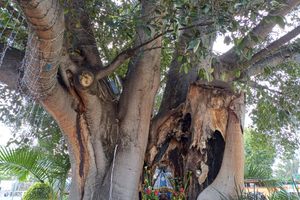
Trees are so central to this town that their imagery features on fountains, murals, tourist signs, souvenirs, and more. With such an important role, it is only fitting that a tree become a shrine to the town’s patron saint, Santa María, or “Holy Mary.” The shrine seems like a callback to several other belief systems. From Yggdrasil in Norse mythology to the role of ceibas among the Maya peoples, trees have often been seen as crucial to the universe, and in some cases even as symbols of existence itself.
With the addition of a fountain that flows from the tree and falls at the Virgin icon’s feet, this tree shrine reminds us of the intersection of nature and belief. While the species of this tree isn’t clear, the specimen seems to have been meant to become a shrine, as it naturally had hollows that were fit for an icon and offerings like candles and flowers.